10 November 2023
What is a theory of change and why does it matter?

There is a huge range of literature about theory of change to be found online. At its simplest, a theory of change is a means of visualising the way(s) in which we think a particular impact is created. This demonstrates 'pathways to impact' by showing how the inputs, activities, outputs and outcomes of an organisation or initiative link together. While simple in its essence, how we develop a theory of change can have a big effect on its value and usefulness.
A theory of change can apply to a whole organisation, a particular program, a cross-organisational partnership or a single event. When actively used and reviewed, a theory or theories of change allow us to assess over time whether we are having the impacts we hope to have, how these are occurring, and whether there are any unanticipated (positive or negative) outcomes occurring because of the approach we have taken to solving a problem.
The table below provides one worked example of how you can set out a theory of change. 'If we' refers to the inputs, 'by' refers to the activities and/or outputs, 'it will result in' refers to the outcomes, and 'and ultimately' refers to the impact.
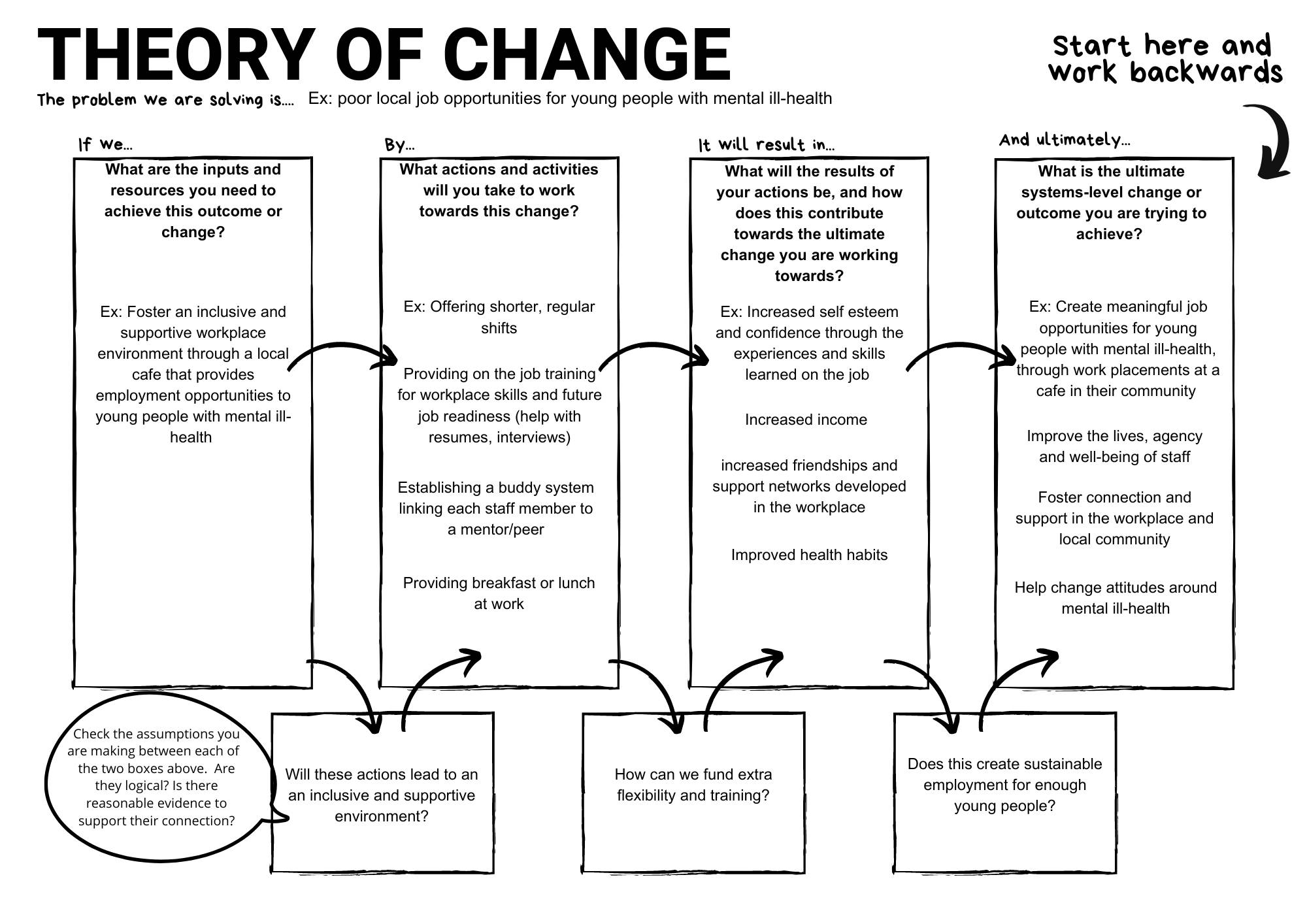
(Adapted from the theory of change canvas in Social Enterprise Fundamentals Workbook1, p.8.)
Hot tip: when developing a theory of change, always start with the impact/problem you want to solve and work backwards!
Some of the benefits of developing a theory of change include:
Some of the limitations of using theories of change are:
Seedkit provides indicators for the inputs, outputs/activities, and outcomes consistent with a theory of change. These can be used to build an online version of your impact pathway(s) to support ongoing review of your organisational or program-level theory of change. Some models of social enterprise have their social impacts 'baked in' to their business model. This means that understanding business fundamentals, such as the cost structures of addressing a particular social need, can be quite important when documenting how a social enterprise achieves results. Use the operations indicators of Seedkit as part of building your impact pathways.
1. Ward-Christie, L., Tucker, J., Riseley, E., & Kelly, J. (2020). Social Enterprise Fundamentals Workbook. Swinburne University of Technology. https://doi.org/10.26185/c11h-y683